Quick Summary: There is no single correct Alliance Championship troop ratio — the right build depends on whether you are assigned a priority lane or a sacrifice lane, and it shifts again once your R4/R5 has scouting data. The ratio table below covers all three lane roles. Win two of three lanes with a 2-1 split, and register only after buffs are active, because your stat snapshot locks at sign-up.
👉 Build your lane split with the Alliance Champion Calculator — it snake-drafts your whole roster across all three lanes automatically.
Alliance Championship is Kingshot's structured alliance-vs-alliance tournament: six alliances in the same bracket, five rounds, and placements that feed alliance tokens, materials, tech progress, and personal loot. If you came here for the troop ratio, your answer depends on your lane assignment — priority and sacrifice lanes run different builds, and both change once leadership has matchup scouting. The ratio table below breaks it down by lane role. Unlike open-world PvP, wins come from lane planning, registration discipline, and communication between rounds — not from last-second hero swaps.
Event structure
Alliance Championship runs on a fixed weekly schedule, starting Monday 00:00 UTC and ending the following Monday 00:00 UTC. The event moves through five distinct phases:
| Phase | What happens |
|---|---|
| Registration (Mon 00:00 – Wed 23:00 UTC) | Players register into one of three lanes. Each lane caps at 20 registrations (60 total per alliance). Your stat snapshot locks at registration — buff before you tap confirm. |
| Matchmaking (Wed 23:00 – Thu 00:00 UTC) | The game groups your alliance with five others of similar tier. No action required from any rank. |
| Prep window (11 hours before each round) | R4/R5 can review enemy lane intel from the prior round and reassign members between lanes. Round 1 is always blind — there is no prior-round data. |
| Battle rounds (5 rounds, Thu–Sat, 1 hour each) | Five automated lane fights. Each round lasts exactly one hour. The battle phase concludes Saturday at 12:00 UTC. |
| Completion (Sat 12:00 – Mon 00:00 UTC) | Final placement (1st–6th within your six-alliance group) pays out alliance and personal rewards. |
Eligibility: You need Town Center 10 to join. Your alliance also needs at least 10 registered members to enter matchmaking.
The Single-Lane Matchmaking Trick: During the Mon-Wed registration phase, ask all alliance members to sign up in the same lane. There is a strong theory that when everyone registers in one lane, the matchmaking algorithm pairs you against easier opponents. Once matchmaking is complete, your R4/R5 can split everyone into the proper 2-1 lane setup during the prep window before the first battle. Even if it's not guaranteed, it's worth trying!
How rounds are won: Taking two of three lanes wins the matchup for that round. If neither alliance clearly wins two lanes, total kills across all lanes breaks the tie — so sacrifice-lane contributions always matter.
The 2-cap rule: Each registered march can defeat at most two enemy units per round. Once a march wins twice or is eliminated, it is done for that hour. That is exactly why splitting strength across two real lanes beats stacking everything into one.
Combat is fully automated. It’s simulated PvP, so your expedition skills are active. Unlike MOBAs like LoL where you can manually control how a lane wins, here you must rely entirely on setup. Use your 3 strongest heroes and optimize your formation to suit your stats. Your registration-time stat snapshot does all the work.
Best Alliance Championship troop ratio
Your troop ratio is not one number — it follows your lane assignment. A lane you intend to win and a lane you are deliberately sacrificing want opposite builds, so check your assignment with R4/R5 before setting your formation.
| Lane role | Infantry | Cavalry | Archers | Use this when |
|---|---|---|---|---|
| Priority lane — default | 50% | 20% | 30% | Lanes 1-2, no scouting data yet. Infantry bulk keeps the fight stable, Archers close it. |
| Priority lane — aggressive | 40% | 20% | 40% | You clearly outpower the opponent, or scouting shows their stack is infantry-light. Less cushion if the fight runs long. |
| Sacrifice lane | 60% | 15% | 25% | Lane 3. Stall and chip kills for tiebreakers rather than chasing an unwinnable win. |
Which row applies to you is the whole question — running the priority default on a sacrifice lane wastes power you needed elsewhere, and running the sacrifice build on Lane 1 loses you the round. If you do not know your lane yet, confirm it before you register, because your snapshot locks at sign-up.
Beyond the table: a cavalry-skew build (~60% Cavalry) is a niche counter when scouting confirms the enemy is anchored on a balanced build. Older Gen 1-2 advice sometimes used 5/4/1-style stacks, and matchup-dependent swings toward 5/2/3, 6/2/2, or extreme splits like 60/40/0 do appear when players counter-scout specific opponents. Coordinate one alliance-wide default first, then deviate only when shot-callers assign exceptions based on actual scouting data — mis-scouting costs more than defaulting.
With your formation set for your lane role, the next question is who goes where.
Lane assignment strategy (the 2-1 split)
Each alliance fields three lanes of up to 20 fighters each (60 total). You only need two lane wins per round, so the winning approach is a 2-1 plan: two power lanes built to win, and one deliberate sacrifice lane that accepts a loss while still chipping kills for tiebreakers.
How to fill the two power lanes — the snake draft: Rank members by combat power, then snake assignments between Lane 1 and Lane 2 until each holds roughly 20 of your top 40. Place remaining players in Lane 3. This keeps both priority lanes elite rather than dumping all top power into a single lane.
If your alliance has fewer than 60 signups, fill the two priority lanes first, then put everyone else in sacrifice. Consistent with how the Alliance Champion Calculator distributes rosters.
Lane 1 — primary
Assign roughly 20 fighters from the top half of your top-40 power list. The goal is to win the lane outright and maximize eliminations up to the 2-cap per march. Hero focus belongs on your highest-investment Expedition heroes. Strong main-lane picks include Amadeus, Petra, and Helga, with late-gen anchors like Triton becoming excellent options when your server has them. Formation: default 50-20-30 or a more offensive split if leadership assigns it.
Lane 2 — secondary
Assign the other half of your top-40. This lane must be built to win — not just to "hold." Losing both priority lanes loses the round regardless of what happens in the sacrifice lane. Hero focus: strong but slightly less carry-oriented lineups — Zoe, Petra, Quinn, Jabel, or cleanup tanks like Helga depending on your roster depth. Formation: 50-20-30 unless executing a counter-build approved by shot-callers.
Lane 3 — sacrifice
Place remaining fighters here — typically the lowest-power registrants who accept an expected lane loss. The goal is to chip kills for tiebreakers and survive long enough to waste enemy eliminations. Hero focus: best survivability options available after the priority draft — Howard, Zoe, Eric, or whichever tanks and buffers remain. Formation: 60-15-25 or other stall-heavy ratios. Minimize premium consumables here.
Losing this lane is acceptable only because you win the other two. But because total kills decide tied rounds, sacrifice-lane players should still fight as hard as possible — do not grief or go AFK.
Shifting lanes between rounds
After Round 1, R4/R5 has an 11-hour prep window before each subsequent round to reassign players based on enemy lane intel from the previous round. Watch for enemies reshuffling too — counter-play is iterative. Pre-write your snake-draft list before the event using the Alliance Champion Calculator so reassignments during the prep window are fast and clear.
Random lane hopping without a shot-caller breaks 2-1 math. Confirm whether your alliance wants everyone registered early or staged for final buff snapshots — then stick to the plan.
Pre-registration preparation — the buff snapshot
Before you register, your power and buff state freeze for the entire tournament. Activate everything first, then register once deliberately.
Pre-battle checklist:
- Toggle pet / combat pet skills that affect march stats (Make sure you activate pet buffs when you register or on your final update to your troops)
- Apply kingdom / alliance appointments your leadership coordinates (Marshal-style march buffs and similar)
- Stack temporary buff items you are willing to consume for the week (ATK%, troop count%, etc.)
- Finish critical research spikes (attack / lethality / troop branches) if they complete before lock
- Equip best Expedition / Fighting march gear on your registered hero trio
- Set your 150-troop formation to the alliance-approved ratio (50-20-30 on priority lanes)
- Confirm lane assignment with R4/R5 before locking a lane slot
If you re-register or update your march without buffs active, you lose the stronger snapshot permanently for that event week. Coordinate with leadership before touching "re-register." This is the most common mistake that costs alliances a full week of competitive standing.
Pro Tip: If another big event like Swordland Showdown is happening at the same time, use your buffs and register for both. You’ll get the benefit of the buffs in both events.
Marshal vs. Field Commander: You can also apply for the military castle buffs. While some groups value Field Commander-style lethality, Marshal generally seems better than Field Commander in most experiences for this simulated PvP mode.
With registration locked and snapshots secured, the round-by-round execution is straightforward.
Round-by-round strategy
Alliance Championship runs five rounds across the six-alliance pool. Placement rewards accumulated round wins — aiming for at least three wins is a healthy target when the bracket allows, but exact tie-break logic depends on your season.
Round 1 (blind): Execute your agreed 2-1 placement. Treat the outcome partly as scouting — you will see enemy lane distributions after this round resolves.
Rounds 2–5: Adjust lane stacks using visible enemy data from prior rounds. Exploit weak lanes, shore up fragile ones, and watch for enemies who also pivot. Your combat buffs should already be locked into the registration snapshot; after that, the main levers are lane swaps, formation exceptions, and clearer scouting calls.
After each round: Share screenshots and summaries fast. The 11-hour prep window closes on a fixed timer, and slow intel sharing is one of the most common reasons alliances fail to counter-adjust.
Kill discipline on sacrifice lanes: Every sacrifice-lane elimination still feeds potential total-kill tiebreakers. Do not treat sacrifice as a reason to play passively — fight hard, accept the lane loss, but accumulate kills.
Hero selection
Generally use your three best heroes. You register your march once, and alliance leadership moves you between lanes, so you do not change heroes based on your assigned lane. These battles are like PvP, so raw power matters.
For F2P rosters, Zoe, Jabel, and Quinn are reliable cores. Prioritize heroes you have actually built instead of chasing paper meta picks.
Rewards breakdown
Individual rewards
Personal payouts scale with damage and KOs relative to other fighters in your alliance who competed. In Alliance Championship, KO means a defeated enemy march. Strong individual performance still pays even when your alliance loses the bracket — another reason not to grief sacrifice-lane players.
| Tier | Representative rewards |
|---|---|
| Top 3 in alliance | Legendary shards, premium chests, large resource bundles |
| Top 10 in alliance | Epic shards, epic gear chests, medium resources |
| Top 20 in alliance | Rare shards, smaller chests |
| Participation | Baseline compensation for registering |
Alliance rewards and season tiers
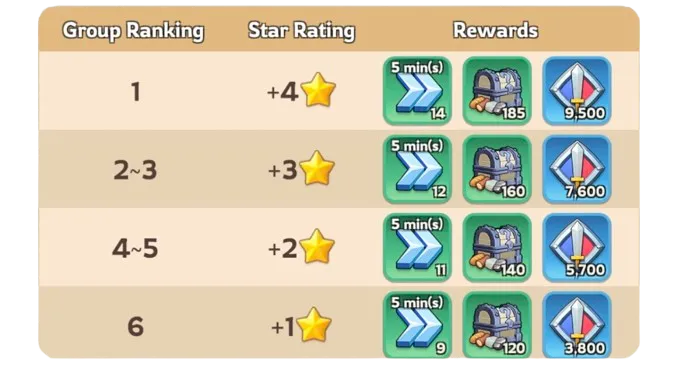
Bracket placement (1st–6th in your six-alliance group) and your league tier determine the season alliance mail. The six tiers are Stone, Iron, Bronze, Silver, Gold, and Diamond. Championship Badges feed the Championship shop, and amounts scale up as tier improves.
The table below shows representative reward categories by tier based on current in-game rewards as of May 2026. Exact badge counts and shop rotations can shift by season, so check your live event screen before planning around specific numbers.
After the six-alliance round-robin, your alliance’s league tier (Stone through Diamond) and group placement (1st–6th) decide these mail rewards. Pick a tier to see the panel; numbers can change by season, so match your live event screen if needed. Separate from per-round KO rewards below.

League tier
Stone
Per-round KO rewards
A different mail track from the season placement rewards above. Payout depends on how many enemy teams your alliance defeats in a round (often Grade 1 vs Grade 2). Confirm rules and amounts on your event screen.
Grade 1 (1 enemy team defeated)
- 5m Research Speedup×10
- 10K Bread×20
- 10K Wood×20
- 1K Stone×40
- 1K Iron×10




Grade 2 (2 enemy teams defeated, or undefeated)
- 5m Research Speedup×15
- 10K Bread×30
- 10K Wood×30
- 1K Stone×55
- 1K Iron×15
Static fallback (if the component above does not render):
| Tier | Badge income (approx.) | Notable exclusive |
|---|---|---|
| Diamond | Highest weekly badge payout | 14-day nameplate / frame cosmetics |
| Gold | High badge payout | Premium material bundles |
| Silver | Mid-tier badge payout | Epic shards, upgrade materials |
| Bronze | Moderate | Rare shards, resources |
| Iron | Low | Basic materials |
| Stone | Minimum | Participation baseline |
Alliance Championship shop: what to buy first
The Alliance Championship shop uses Championship Badges and improves as your server ages. The best buy is usually the current hero shard if you are building that hero, then long-term upgrade bottlenecks, then skill books or speedups only when you have a specific need.
Hero shard slot
| Server age | Hero shard | Qty | Badge price | Weekly limit |
|---|---|---|---|---|
| Days 1-196 | Gordon Shard | 1 | 500 | 25 |
| Days 197-280 | Marlin Shard | 1 | 2,000 | 10 |
| Days 281-364 | Eric Shard | 1 | 2,000 | 10 |
| Days 365-448 | Margot Shard | 1 | 2,000 | 10 |
| Day 449+ | Vivian Shard | 1 | 2,000 | 10 |
Buy these only if the hero fits your account plan. Gordon is cheap enough to matter early, but later hero shards are expensive; do not drain badges on a hero you will not build.
Permanent progression items
| Unlock timing | Item | Qty | Badge price | Weekly limit |
|---|---|---|---|---|
| Always | Gilded Threads | 1 | 100 | 100 |
| Always | Satin | 1 | 1 | 10,000 |
| Server Day 55+ | Growth Manual | 1 | 150 | 30 |
| Server Day 113+ | General Master Emblem | 1 | 1,500 | 15 |
| Server Day 113+ | Master's Manuscript | 1 | 15 | 1,000 |
| Server Day 176+ | Artisan's Vision | 1 | 500 | 5 |
For most players, Gilded Threads and the relevant server-age progression items are safer buys than dumping badges into generic resources. General Master Emblems are worth targeting when they unlock a real Master skill breakpoint; Master's Manuscripts are cheap, but only useful if they are actually blocking your next upgrade.
Extra items
| Item | Badge price | Weekly limit |
|---|---|---|
| 1h Training Speedup | 400 | 5 |
| 1h Healing Speedup | 400 | 5 |
| 1h Construction Speedup | 400 | 5 |
| 1h Research Speedup | 400 | 5 |
| Rare General Hero Shard | 200 | 100 |
| Epic General Hero Shard | 600 | 25 |
| Mythic General Hero Shard | 2,500 | 2 |
| Mythic Conquest Skill Book | 500 | 10 |
| Epic Conquest Skill Book | 250 | 10 |
| Rare Conquest Skill Book | 75 | 10 |
| Mythic Expedition Skill Manual | 500 | 10 |
| Epic Expedition Skill Manual | 250 | 10 |
| Rare Expedition Skill Manual | 75 | 10 |
| Nutrient Potion | 750 | 5 |
| Promotion Medallion | 1,500 | 2 |
| Advanced Taming Mark | 3,000 | 1 |
Treat this pool as situational. Skill books and manuals are useful when a specific hero skill is waiting on them. Speedups are convenience buys, not the main reason to play Alliance Championship. Advanced Taming Marks are valuable, but expensive enough that you should compare them against your current hero shard and gear-material needs before buying.
Is Alliance Championship worth participating in every week?
Yes — and the compounding effect is the main reason. Each week of participation adds Championship Badges toward the shop, advances your alliance toward a higher tier bracket, and contributes to the personal shard and material income that funds hero progression. Missing one week does not reset your tier, but it costs a week of badge accumulation that cannot be recovered within the same season.
For F2P players, Alliance Championship is among the best weekly sources of alliance tokens and hero shards without spending. For low spenders, it is a high-ROI event when buff timing is disciplined — moderate investment yields strong returns. For whales, it is the spotlight event that converts account power into exclusive currency and proves build quality in a competitive bracket. The coordination overhead is real — R4/R5 prep, snapshot discipline, and post-round intel sharing all take time — but for alliances that actually run the event properly, the weekly return justifies the investment at every spending level.
Advanced tactics
Reading and exploiting enemy lane history
After Round 1, R4/R5 can see how the enemy distributed their players across lanes in the prior round. Two high-value adjustments:
Scenario 1 — The Classic Counter Triangle: Use battle history to map their lanes, then arrange your teams to ensure you win two lanes:
- Your Weakest Lane → vs. their Strongest Lane
- Your Strongest Lane → vs. their Second Strongest Lane
- Your Second Strongest Lane → vs. their Weakest Lane
This guarantees your two strongest lanes avoid their heaviest hitters and gives you a very high chance of winning 2 out of 3 lanes.
Scenario 2 — They leave a lane chronically thin: Shift extra power into that lane for a near-guaranteed third-lane win while your two priority lanes hold their assignments.
The caveat: This strategy mostly works against alliances that don't change lanes. At higher tiers, most alliances shuffle lanes regularly — and you should too! Keep your lane setup unpredictable to avoid being countered, because you are always reacting to their prior-round data. Build in a fallback assumption when scouting is ambiguous.
Consumable pacing
Because Alliance Championship uses a registration snapshot, do not plan around activating ATK +%, lethality +%, or troop swell items after Round 1. Decide before registration whether this is a full-buff week. If the bracket is not worth heavy investment, save those consumables for a future Championship week rather than expecting them to swing later rounds.
Communication protocols
- One shot-caller per event week for lane doctrine, formation exceptions, and swap decisions
- A dedicated thread or channel for post-round screenshots immediately after each battle resolves
- A pre-written snake-draft list exported from the Alliance Champion Calculator so reassignments happen in seconds, not minutes
Mistakes that cost rounds
- Splitting power evenly across all three lanes (1-1-1) when 2-1 wins more brackets
- Signing up without knowing whether you are in a priority or sacrifice lane
- Re-registering without buffs active and losing the stat snapshot
- Spending premium consumables on Round 1 with nothing left for decisive rounds
- Using the wrong hero skill mode — confirm Expedition talents before lock-in
- Ignoring kill totals on the sacrifice lane during tiebreaker scenarios
- Solo lane hopping without leadership approval
F2P, low spender, and whale priorities
F2P: Lock a lane role early with leadership. Default to 60-15-25 or the alliance-standard defensive ratio when assigned sacrifice. Prioritize consistent damage over burst you cannot sustain. Use limited buff items before registration only when the week is worth the spend; otherwise save them for a future Championship. A realistic target is top-10 individual whenever coordination is clean.
Low spender: Buy ATK / lethality bundles your roster converts efficiently. Feed shards into main-march Expedition heroes rather than spreading across multiple legends. Snap buffs once, correctly, before registration. Target top-5 individual while securing round wins.
Whale: Request priority lane placement — that is where excess power converts to 2-1 victories fastest. Max combat research before the event. Mythic / red gear on the registered march only. Coordinate swaps actively — carrying one priority lane is not enough if the second priority lane drops.
FAQ
What is the best Alliance Championship troop ratio in Kingshot?
It depends on your lane assignment. Priority lanes (the two you intend to win), sacrifice lanes, and aggressive counter-builds each use a different split — see the lane ratio table for all three, plus when each one applies. Confirm your lane with R4/R5 before you register, since your stat snapshot locks at sign-up.
When should I register for Alliance Championship?
Register after your combat buffs, pet skills, appointments, gear, heroes, and troop formation are set. Alliance Championship saves a registration snapshot, so updating your march later without those buffs can weaken your locked setup for the week.
What should I buy from the Alliance Championship shop?
Prioritize permanent progression items first: Widgets or hero-exclusive gear items when available, then charm and gear bottleneck materials, then Master Academy materials if your server has unlocked Masters. Buy speedups and generic resources only after the high-value progression items are cleared.
What does KO mean in Alliance Championship?
KO means a defeated enemy march. A registered march can score up to two enemy defeats per round before it stops fighting for that hour.
Should I use Field Commander for Alliance Championship?
You can also apply for military castle buffs. While some groups value Field Commander-style lethality, Marshal generally seems better than Field Commander in most experiences for this simulated PvP mode.
Putting it all together
Alliance Championship rewards alliances that treat it like a mini sport season: locked registrations, clear lane doctrine, Expedition hero discipline, and adaptive leadership between rounds. The alliances that keep winning are the ones that execute cleanly every round.
Six things to carry into your next event:
- Six alliances, five rounds, win each matchup by 2 of 3 lanes — total kills still matter for ties.
- Default 50-20-30 on priority lanes; skew only with scouting and leadership approval.
- Run 2-1 lane power: snake-draft the top ~40 across two lanes, sacrifice the third.
- Buff snapshot once — pets, appointments, consumables, gear — then register deliberately.
- The 2-cap per march is why two lanes beat one mega-lane every time.
- Confirm every timer, eligibility rule, and tie-break in your live client — competitive events change seasonally.
For hero synergies, see Best Hero Combinations. For gear priorities, see the Gear Guide. For long-term progression, pair this with the Master Academy Guide.
Need help or spotted something off?
Join the Kingshot Mastery Discord for hero builds, event routing, quick answers, and guide corrections from other players.